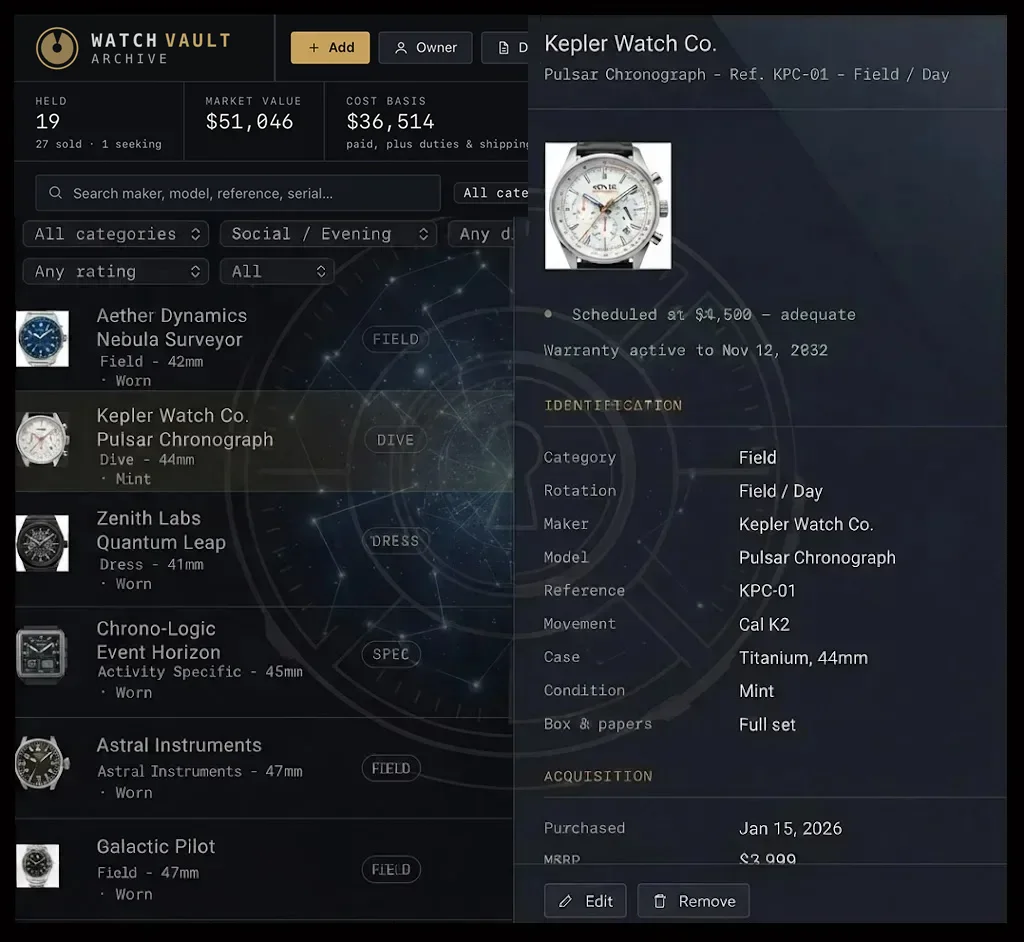
Watch Vault Archive is private desktop software for cataloging a watch
collection — appraisals, service history, provenance and succession,
held encrypted on your own computer. There is no cloud, no account, and
no company holding a copy of what you own.
For macOS and Windows · A one-time licence, not a subscription
In plain terms
What Watch Vault Archive is.
Watch Vault Archive is desktop software for cataloging and tracking a watch
collection — an encrypted inventory, appraisal and service-history app for
macOS and Windows. It records what you own, what you paid, what it is worth
now, who has serviced it and who inherits it, and keeps all of it on your
own computer. It is the replacement for the spreadsheet most collectors
outgrow, without becoming another cloud account holding a list of your
valuables.
Who it is for
Anyone keeping a record of watches they own.
Three watches or three hundred. Some collectors need an insurance
schedule and an estate register; others simply want to stop losing
receipts and forgetting what a piece cost. The same record serves
both, and the one you start early is the one that still works later —
starting out,
a growing collection,
buying and selling, or
a significant
collection.
What it replaces
A spreadsheet, or a cloud collection app.
A spreadsheet holds the data but produces nothing: no insurance
schedule, no estate register, no service reminders, no attached
appraisals, and no encryption worth the name. A cloud app produces
those things but requires uploading photographs, serial numbers and
valuations to a company you have never met. Watch Vault Archive produces
the documents without the upload.
What it produces
Documents an underwriter or executor can use.
A scheduled property inventory for insurance — every piece,
reference, serial number, appraised and insured value, with anything
underinsured flagged. An estate register for an executor, grouped by
your instructions. Both print, and both stay on your computer until
you hand them over.
Where it runs
On your own Mac or PC, offline.
A native desktop application for macOS 11 or later and Windows 10 and
11. It installs like any other program, needs no account, and works
identically on a computer that has never been connected to the
internet. There is no phone app, and
that is
deliberate.
What it costs
$149 once, not a subscription.
A one-time personal licence, perpetual for the product generation you
buy and including updates within it. Nothing recurring, no account to
maintain, and nothing that stops working if the company does —
because the software does not depend on anything we run.
Who it’s for
Built for a collection of five, and one of five hundred.
Nearly every collection starts with two or three watches and a spreadsheet
that has already become annoying. It ends up somewhere none of us planned.
Most collectors are more than one of the following at once and move between
them over years — so these are stages, not categories, and the record you
start at the first is the one that still works at the last.
You have a handful of pieces and a spreadsheet, or nothing at all. What matters now is starting a record you will not have to rebuild later — and learning what a service costs before it surprises you.
The collection has outgrown memory. Some pieces are worth insuring and some are not, you are tracking what you want as well as what you own, and you need to know which is which without opening five files.
You sell as well as buy. That means cost basis, duties, shipping, servicing and commission — and a "sold or lost" figure that is honest rather than the one that flatters you.
Enough value that an underwriter, an executor or an appraiser will eventually read your records. Provenance, scheduled values and an estate register stop being optional.
Two things that apply at every size — and one that does not
Your data stays on your own computer, encrypted, whether you have five
watches or five hundred: there is no account, no upload, and no company
holding a copy. The price is the same at every size — $149 once, not
a subscription. The exception is commercial use: a
dealership, auction house or anyone holding inventory to sell needs a
separate licence, which is a conversation rather than a checkout —
legal@watchvaultarchive.com.
Privacy and discretion
A collection worth insuring is worth keeping private.
Most collection apps ask you to upload photographs, serial numbers and
valuations to somebody else’s server. That creates a single,
attractive list of what you own and where you live. Watch Vault Archive was
built so that list cannot exist anywhere but your own computer.
No servers
There is nothing to breach.
No account to create, no password to be leaked in someone else’s
data breach, no vendor database quietly holding an inventory of your
watches. Your collection exists on your computer and nowhere else.
Offline by design
The application cannot send your data anywhere.
This is not a setting you have to trust us to honor, and not a
promise of restraint. The application is built without any network
capability at all — no connection to make, no address to send to. It
works exactly the same on a laptop that has never been online.
Encrypted at rest
A stolen laptop reveals nothing.
Everything — watches, values, serial numbers, photographs and attached
documents — is encrypted on disk, sealed with the same key. Someone who
takes the computer, removes the drive and reads it directly gets
unreadable data. There is no lock to pick, because the information
itself is scrambled.
Confidential
We cannot see your collection, even if asked.
The key that opens your collection is derived from a passphrase only you
hold, and it never leaves your computer. There is no copy in escrow and
no mechanism by which we could produce your data for anyone — a support request, an insurer, or a subpoena. We simply
do not have it.
It began as one collector’s own record. That is why it handles the
tedious, consequential things carefully and none of the flashy things at
all.
01
Appraisals and insurance schedules
Produce a scheduled property inventory — every piece, reference, serial
number, appraised value and insured value — to hand to an underwriter or
attach to a claim. Anything worth more than it is covered for is flagged
before you find out the hard way. Formal appraisals, invoices and
warranty cards attach to the record and are encrypted alongside it. A
renewal line surfaces automatically inside sixty days of a policy’s
date, naming the insurer, the watches on it, and how the scheduled
total compares to what they’d cost to replace.
02
Service history
Log every service, the house that performed it, what it cost and when
the next is due. A complete, dated service record is part of what a
piece is worth — and it is among the first things a serious buyer or an
estate appraiser will ask to see.
03
Provenance
Where a piece came from, who owned it before you, the box and papers,
the auction lot, the story. Held with the record rather than in a drawer
of receipts, and encrypted with everything else.
04
Succession
An estate register prints what your executor will actually need: what
these pieces are, what they are worth, which are promised to a named
person and which may be sold. You can also leave an encrypted copy of
the whole collection with your estate documents.
05
An honest position
Two figures, deliberately kept apart. What the collection might be worth
today, from your own valuations — an estimate. And what actually
happened when you sold: hammer price, less commission, less what the
watch cost you to buy — price, duties and shipping. Servicing sits
alongside it as a cost of ownership, not buried inside the trade.
06
The hunt
Mark a piece as sought and it sits in the collection as part of the chase
— excluded from every financial total and from both printed documents, because you
do not own it yet. Record the purchase and it joins the collection on
its own.
07
Insights
A timeline of what the collection was made of, on any date it changed
— grouped by category or brand, measured by count, cost basis or
market value. Nothing is stored separately; it is read straight back
from the purchase and disposal dates already on the pieces, so it can
never disagree with them.
08
Rate, amplitude and beat error
Record what a timing run measured and compare it against the tolerance
you choose — COSC, METAS Master Chronometer, Grand Seiko, Rolex’s
Superlative standard, or a plain ±10 seconds a day. The
application compares; it does not certify. Amplitude and beat error sit
alongside as the two numbers on a timing sheet that say a watch is
heading for a service.
A working example of a sample transaction
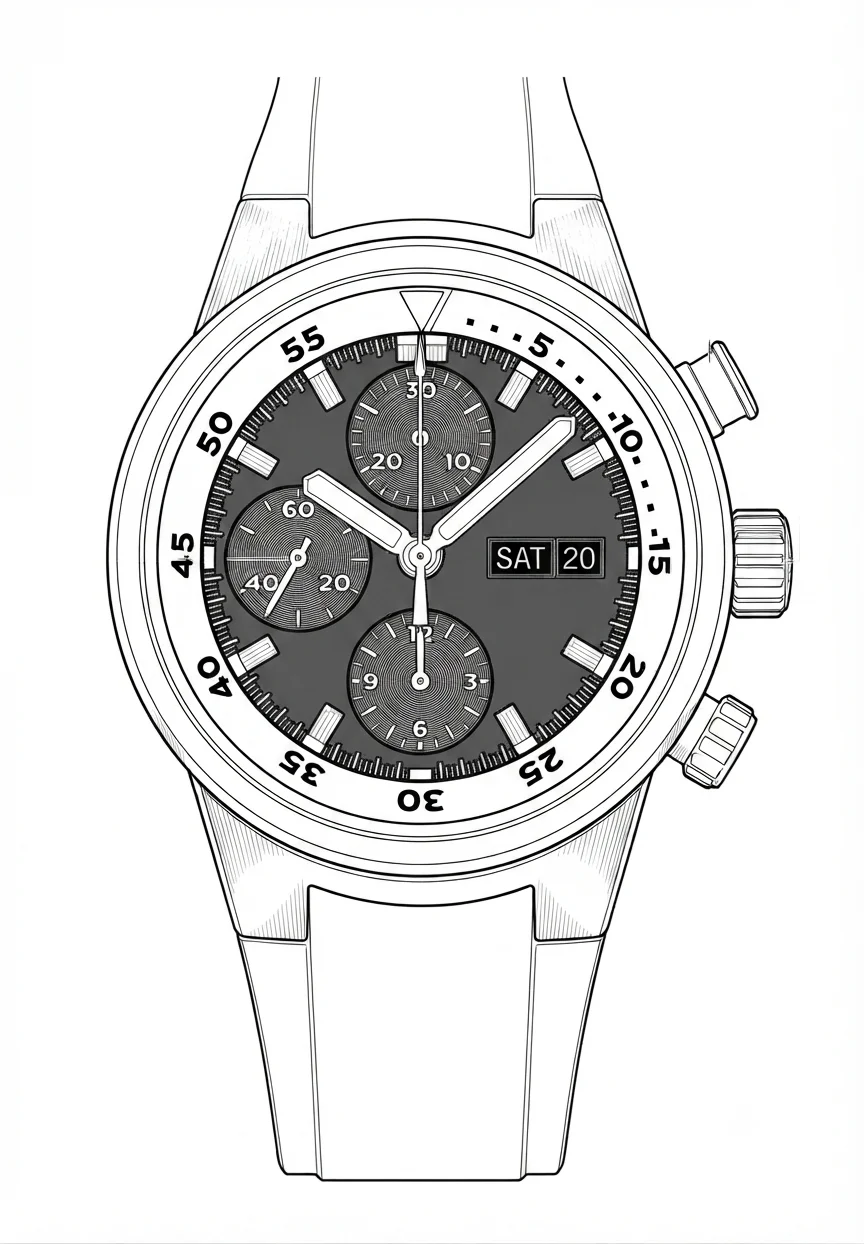
A dive chronograph, bought at auction for $2,810, plus $80 in duties and
shipping — a cost basis of $2,890. Today’s market value is
$7,500Provenance. Compare only to the
purchase price and the gain looks like $4,690; against what the watch
actually cost to acquire it is $4,610. One service call
for $615 is carried separately, as a cost of owning the watch rather
than of buying it — so you can see the trade and the upkeep without
either one hiding the other.
A watch record holds a great deal — references, dates, service entries,
what you paid, what it is insured for. The story is what you choose to
make from it: the photographs, how the watch came to you, what has been
done to it, and your own note about why you keep it. There are no prices
or valuations in it, because that is not what a watch means to you, and
it is not what you would want read out.
What is in it
The photograph first, then the history.
Matted rather than cropped, so a careful phone shot carries the same
weight as a studio one. Then how the watch was acquired and who has
owned it, written as prose rather than fields. What it is.
Originality, component by component. Mechanical health, verdict
first. The remaining photographs, captioned. How it is kept, and
what should happen to it.
Your own words, last
A note about why you keep it.
Optional, never required, and written by you rather than generated
for you. It carries the date you wrote it rather than the date the
file was saved, and it sits apart from everything else — closer to a
note left inside a book than to the rest of the document.
Yours to give
The one thing here meant to leave.
It reads on its own page in the application and saves as a single
file. Print it, keep it, or hand it to whoever should have it. It is
your account, in your words — nothing in it was issued by a
manufacturer or an appraiser, and it does not pretend otherwise.
Sections with nothing recorded are left out rather than padded, so a
thinly documented watch produces a shorter document. Every watch is
honest; not every watch is equally impressive.
Security and encryption
One key, held only by you.
The collection is protected with AES-256 encryption — the standard used to
protect classified government information and banking systems.
Your passphrase
The only thing that opens it.
The application opens locked and stays locked until you enter it. It
locks itself again on an idle timer, and locking discards the key
entirely — a locked collection is not a screen drawn over readable data.
There is nothing to read.
Recovery key
A second way in, on paper.
A recovery key is shown once during setup, to be written down by hand.
It opens the collection independently of your passphrase, and belongs
where your important documents live — a safe, a deposit box, or with
your attorney. There is no button to print or copy it: either would
put the key on the computer it exists to protect.
Backups
An encrypted file you control.
Export the entire collection — photographs and documents included — as a
single encrypted file. Keep it on a drive in a safe, or hand it to an
executor. It is unreadable without your passphrase, so where it rests
matters far less than it otherwise would.
There is no reset
No backdoor, no escrow, no support line that can let you back in. If you
lose both your passphrase and your recovery key, the collection cannot be
opened by anyone, permanently. That is the same property that makes a
stolen laptop survivable: any door that could let you back in could let
someone else in too. We would rather tell you this now than at the worst
possible moment.
A collection like this gets reviewed a few times a year — checking
provenance, confirming coverage, deciding what happens to it — not checked
on the subway. That is a sit-down task, and building a synced companion for
it would mean solving a different problem than the one this app was built
to solve.
What syncing to a phone requires
A server holding a master copy, so two devices have something to compare against
Or that same server resolving conflicts when you edit from both at once
What Watch Vault Archive does instead
One copy, on one computer, that has never been reachable from anywhere else
Moving it is a deliberate act — export a vault file, carry it yourself — never a background sync you stopped watching
A companion app to look up a single piece — serial, insurance, photos —
would be a separate product with its own storage, and might happen later.
It would not be a synced copy of this one.
More in the FAQ →
Pricing and licensing
Bought once. Yours to keep.
Watch Vault Archive is a proprietary desktop application for macOS and
Windows, sold under a one-time personal licence. Not a subscription, and
not a service that can be switched off out from under your records —
because it does not depend on anything we run.
Use inside a dealership, auction house, or any other business requires a
separate commercial licence.
legal@watchvaultarchive.com.
Watch Vault Archive
Coming Winter 2027
$149one-time · perpetual licence
Coming to the Mac App StoreWinter 2027Coming to the Microsoft StoreWinter 2027
Ten watches without a licence, permanently, with every feature
working. $149 once removes the limit and adds nothing else.
Sold through the Mac App Store and the Microsoft Store, which
handle the sale, the tax in your jurisdiction, and your record of
owning it.